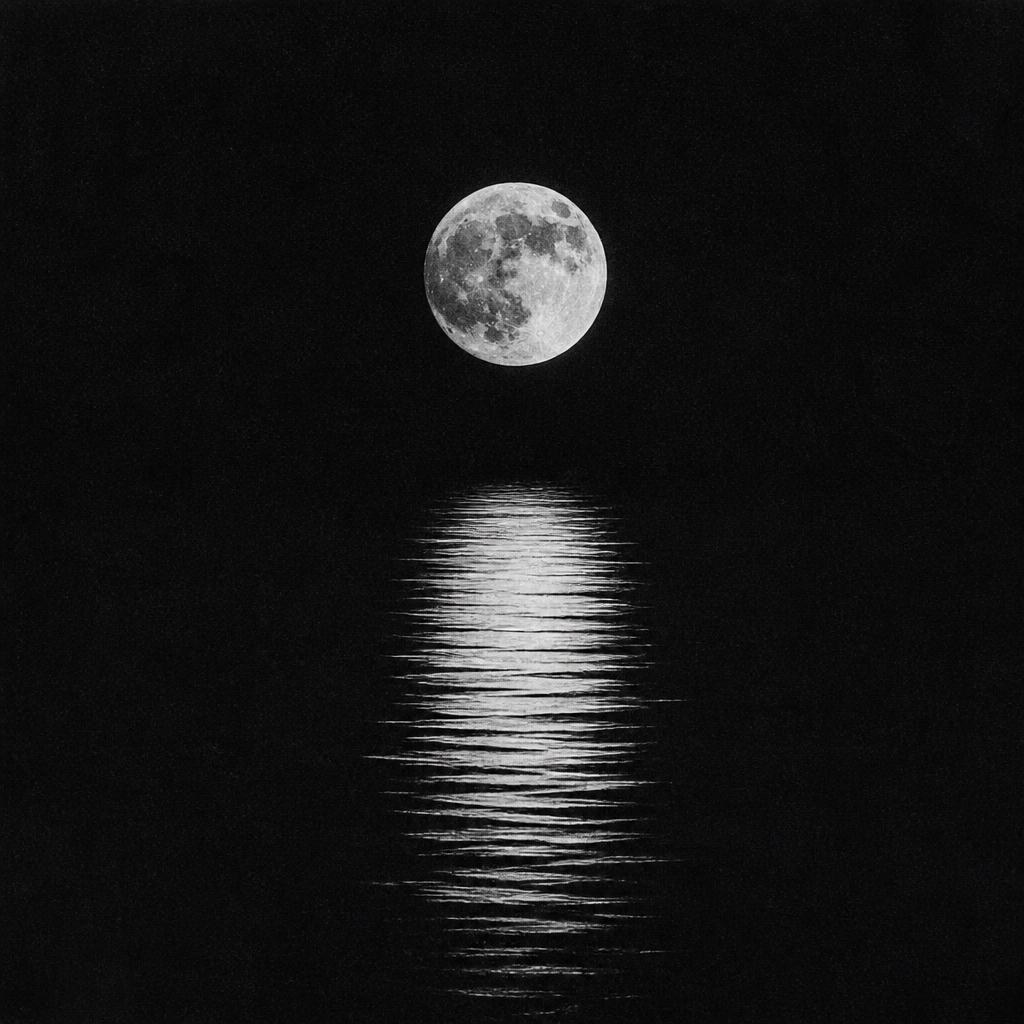
The recipe, in case you've missed it: take a jar of drinkable water, leave it outside or on a windowsill under a full moon, collect it in the morning, and use it however feels right: water the plants, rinse your crystals, splash some in the bath, or feel slightly magical while making tea. That's moon water. It is currently all over the internet, and it provokes exactly two reactions: 'obviously nonsense' and 'wait, which nights?' This article is for both camps, because both are slightly wrong and both are slightly right.
Let's settle the chemistry first, kindly. Moonlight is sunlight reflected at roughly four hundred thousandths the intensity; it carries no exotic energy, changes no molecular structure, charges nothing. Water that has sat under a full moon is, chemically, water that has sat outside overnight. Anyone who tells you the moon restructures it is selling something, possibly a jar. If you came for permission to skip the pseudoscience: granted, fully. Moon water is just water.
And yet the ritual persists, across centuries and continents, in folk traditions that never met each other. It persists because the active ingredient was never the moonlight. Watch what the recipe actually makes you do. You checked a lunar calendar, which means you located yourself in a monthly rhythm. You went outside at night, which most adults now do approximately never. You looked up, found the moon, stood still for a minute under the largest object you'll ever see. And you decided, deliberately, that something ordinary was going to carry a meaning. That sequence, attention, pause, intention, marking, is not nothing. It's close to the whole technology of ritual, in one jar.
Psychology has a dry name for this: the ritual effect, and the research on it is surprisingly robust. Structured, deliberate sequences of action measurably reduce anxiety, sharpen subsequent focus, and increase follow-through on intentions, and here's the kicker: studies find they work even when participants know the ritual has no causal mechanism. Basketball players with free-throw routines, test-takers with lucky pens, grievers with candle-lighting rites: the choreography itself regulates the nervous system. The brain treats 'marked' actions differently from unmarked ones. Moon water is choreography with excellent production design.
There's also the matter of what the jar does afterward, which is where the practice quietly earns its keep. A bottle of plain water is invisible. A bottle of June's full moon water, labeled, sitting on your desk, is a physical bookmark of a specific night and whatever you were carrying through it. Drink it during a brutal Wednesday and you get a small involuntary memory of standing in the dark feeling calm. Psychologists would call it a conditioned cue. Practitioners would call it drinking the intention. The descriptions cash out identically, which is usually the sign of a practice worth keeping.
If you want to do it properly, the tradition has opinions, and they're charming even read as pure folklore. Full moon nights are the classic: peak light, peak culmination, water for finishing and clarity. Some practitioners also bottle new moon water for beginnings, though purists argue the dark moon has nothing to give a jar. The lore says skip eclipse nights (chaotic energy, allegedly) and don't fret if clouds roll in; the moon, they insist, doesn't need line of sight. Use a lidded glass jar if bugs are a possibility. If you'll drink it, treat it like any water left out overnight: your kitchen windowsill is as lunar as the garden.
The label is the most underrated step, and it's the one to keep even if you drop everything else. Write the date and one phrase: what this month is for. 'The move.' 'Less rescuing.' 'Finish the draft.' The jar now holds your headline for the lunar month, and every glass of it is a small renewal of the contract. This is the same mechanism as the new moon sentence, the 11:11 pause, the Saturn-return inventory: a physical anchor for an intention that would otherwise evaporate by Thursday. Astrology's rituals are, over and over, memory devices wearing costumes.
Is there a risk of taking it too seriously? Only the usual one: mistaking the prop for the mechanism, buying seventeen jars, arguing about whether Tuesday's moon was 'too Scorpio' for hydration. If you find yourself optimizing moon water, the pause has become homework, and the entire point was the pause. The correct dosage of this ritual is: occasionally, lightly, on nights when the moon is fat and you remember.
So make the moon water. Tonight, if the sky cooperates. Not because the moon will change the water, but because the water will change the night: you'll have gone outside, looked up, and decided on purpose that something ordinary means something. Label the jar with what this month is for. When you drink it you'll remember, and that, precisely, is the spell.