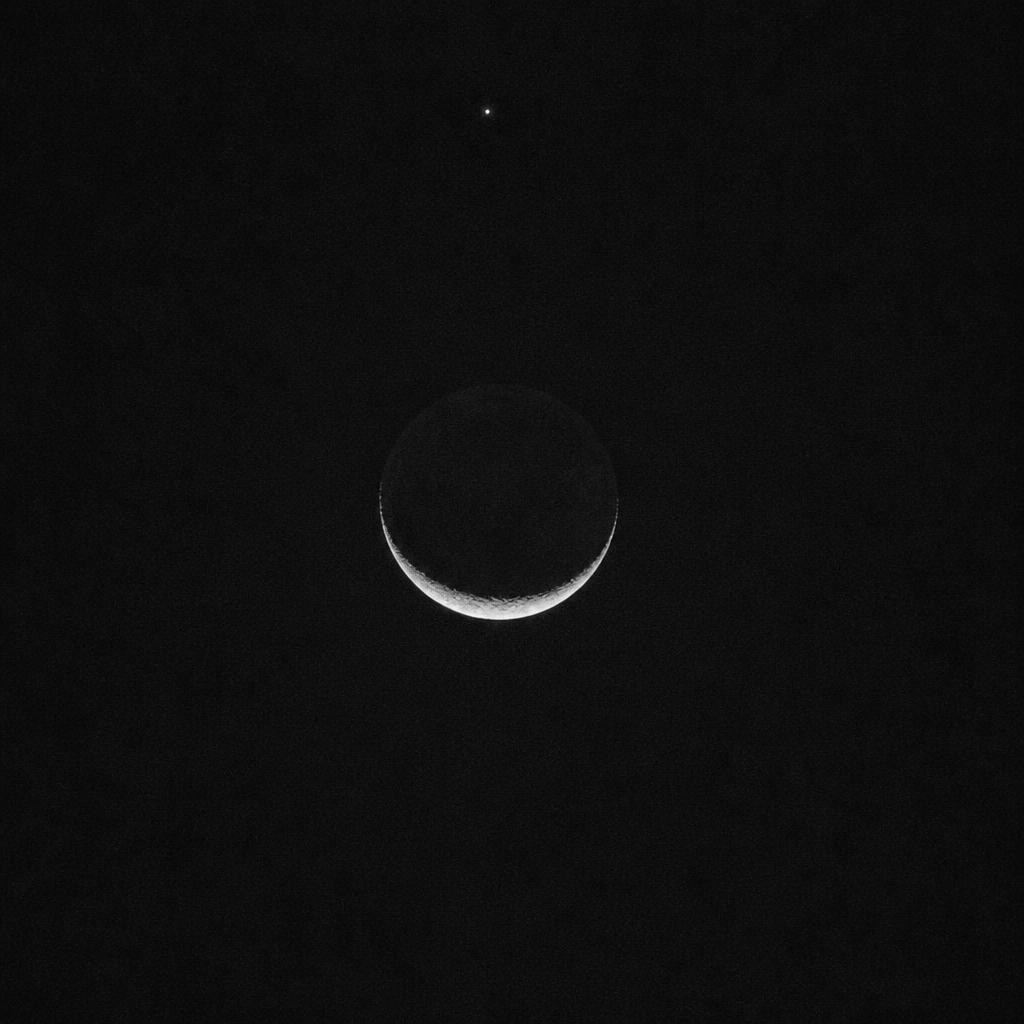
Once a month the moon goes dark, and the internet fills with elaborate new moon rituals: crystal grids, herb-infused baths, manifestation journals with chapter headings, playlists, altar layouts, moon circles with attendance policies. If that's your joy, genuinely, enjoy; nothing here is against candles. But somewhere under the production values is a five-minute practice that works in a kitchen, in work clothes, with nothing but a pen. This is that version.
First, what a new moon actually is, because the mechanics explain the meaning. The moon sits between Earth and the sun, its lit half facing entirely away from us, and for a night or two it simply vanishes: no crescent, no glow, nothing to look at at all. The sky's brightest recurring object goes absent. Every almanac tradition read that absence the same way: zero. The ledger closes, the page turns, the month begins again in the dark. Seeds were planted at the new moon not because moonlight feeds seeds but because beginnings belong at the beginning.
The logic of a new moon ritual is just clean timing. Humans are spectacularly bad at acting on vague intentions ('I should call her', 'I want to write more') and measurably better when an intention is hitched to a recurring cue. Behavioral scientists call the broader effect the fresh start effect: we pursue goals more readily right after a temporal landmark, a Monday, a birthday, a January 1st. The new moon is a fresh start that arrives thirteen times a year, visibly, on schedule, without a hangover. A monthly zero is a good hook for the kind of small intention you'd never put on a calendar otherwise.
So here is the entire core ritual, and it takes one sentence: write down what this month is for. One sentence, not five. 'This month is for finishing the application.' 'This month is for being outside more.' 'This month is for not rescuing people who didn't ask.' The constraint is the mechanism; a single sentence forces the month to have a headline, and a month with a headline reads differently from the inside. Put the sentence somewhere you'll collide with it: a sticky note on the monitor, a note pinned on your phone, the first line of a notes file you'll reopen at the full moon.
If you have two more minutes, add the deletion. New moons are for clearing the ground a seed goes into, so remove exactly one thing: an app you doomscroll, a draft that's been guilt-staring from the desktop, a subscription, a grudge with low mileage. One is enough. The point isn't decluttering your whole life in an evening; it's marking the reset with a single irreversible gesture, because gestures are what make a date feel like a beginning instead of a Tuesday.
And if you have five: send one text. The new moon version of 'manifesting community' is messaging one person you want more of this month and saying something true: 'thinking of you, let's get dinner soon.' Months bend surprisingly hard around who you contact in their first 48 hours. That's not mysticism; that's just how calendars and friendships actually work, and the moon makes a decent excuse.
A few notes on form, learned the hard way by everyone who's kept this up for a year. Write the intention as something you do, not something you attract; 'I write Tuesday and Thursday mornings' survives contact with reality better than 'abundance flows to me'. Keep it one month wide; 'fix my career' is a Saturn project, not a lunar one, but 'update the portfolio' fits neatly between two new moons. And check back at the full moon, two weeks in, when the sky is at maximum wattage: that's the traditional midpoint review, the night you ask 'is the headline still true?' and adjust. Intention at the dark, assessment at the light. The month has a built-in editorial calendar.
Do you need the moon for any of this? Honestly, no. You could do it the first of every month. But pinning it to the sky does something the calendar doesn't: it makes the practice ambient. You see the thin crescent return a couple of nights later and remember the sentence. You catch the half moon over a parking lot and do the math: one week to the review. People who anchor habits to the moon report the habit reminding them, which is the entire battle with habits.
That's it. No candles were harmed. Write the sentence, delete the thing, send the text, and go to bed; the whole rite fits inside the time the kettle takes. The moon doesn't check your supplies, and it doesn't grade on production values. It just comes back around in 29 days, politely, like a good editor, to see what you did with the blank page.