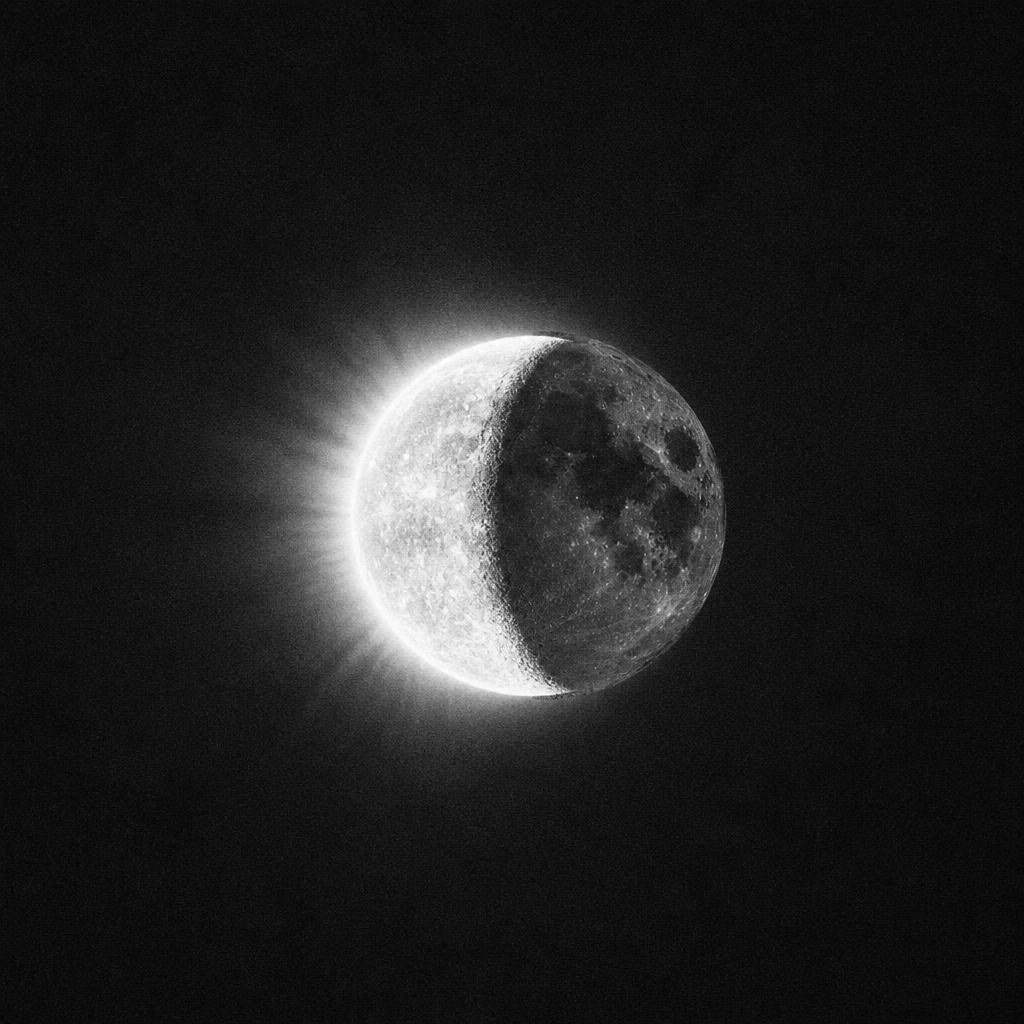
Ask someone their sign and you'll get one answer: 'I'm a Taurus.' But a birth chart holds three headliners, and astrologers never read one without the others: the sun (your engine), the moon (your inner weather), and the rising sign (the front door other people walk through). Together they're called the big three, and learning yours is the single biggest upgrade you can make to how astrology reads for you. Most 'astrology doesn't work on me' complaints dissolve right here.
The sun is the one you already know, because it only takes a birthday to find. The sun moves through one sign per month, so everyone born in late April is a Taurus, full stop. In a chart it describes purpose and vitality: what you're here to do, what generates your energy, the verb of you. When a horoscope says 'Leos are performers' it's describing the engine, not the whole car. Plenty of Leos are shy. The engine still wants an audience; it just may want one quietly.
The moon is the private layer, and it's set by the time and place of your birth, because the moon changes signs every two and a half days. Two babies born the same week can carry completely different moons. In a chart the moon covers needs, instincts, and emotional habit: what you require in order to feel safe enough to do the sun's work. A Capricorn sun with a Pisces moon climbs the mountain but needs to cry at the summit. An Aries sun with a Taurus moon charges forward but needs the same dinner at the same table afterward. When a reading feels wrong, it's usually because it described your sun while you were busy being your moon.
The rising sign, also called the ascendant, is the constellation that was coming over the eastern horizon at the exact minute of your first breath. It changes roughly every two hours, which is why astrologers are so annoying about needing your birth time. The rising governs first impressions and packaging: the version of you that strangers, coworkers, and first dates meet before the rest of you arrives. It's the answer to a question your friends could settle instantly: 'what did you think of me when we met?' A Scorpio rising gets called intimidating by people who've never seen the goofy Sagittarius sun underneath.
The rising sign also explains the most common astrology complaint in existence: 'I don't feel like my sign.' Of course you don't, necessarily. Strangers mostly meet your rising. You mostly feel your moon. Your sun is what you're growing into across a lifetime, and plenty of people don't settle into their sun until their thirties. All three descriptions are true at once, the way a house has a facade, a living room, and a furnace, and nobody calls the house a liar for having all three.
There's a practical reading trick that falls out of this, used by almost every working astrologer: read the daily horoscope for your rising sign as well as your sun. Daily horoscopes are built on the houses, the twelve domains of life, and the houses are anchored to the rising sign. For most people the rising-sign horoscope describes events and circumstances more accurately, while the sun-sign one describes mood. Try both for a week and notice which lands. It's the cheapest experiment in astrology.
How the three interact is where charts get genuinely individual. The combinations run to 1,728, before you touch the other planets. A Cancer sun, Cancer moon, Cancer rising person is the undiluted article, what astrologers call a triple, rare and unmistakable. A Libra sun with an Aries moon negotiates peace publicly while craving the fight privately. Some big threes pull in one direction and feel seamless; some hold real tension, and that tension is usually the person's central storyline. If your three argue with each other, that's not a flaw in the system. That's the system describing why you argue with yourself.
Finding yours takes five minutes and two facts: birth date gets you the sun, and birth date plus time plus city gets you the moon and rising. The time matters; 'sometime in the morning' can be the difference between a Virgo and a Libra rising. Birth certificates usually record it, and parents remember more often than you'd think. If the time is truly lost, you can still get sun and (usually) moon, and astrologers have a whole detective practice called rectification for reconstructing the rest, but start with the paperwork.
Start with the sun on our find-my-sign page, then chase down the other two; they're worth the small detective work. Once you have all three, reread any horoscope that never used to fit. It's a different book when you know which character you're playing on which page. And the next time someone asks your sign, you're allowed the long answer. The short one was only ever a third of the story.